Wenatchi-P’squosa Were Active Near Lake Wenatchee – 7/25/25
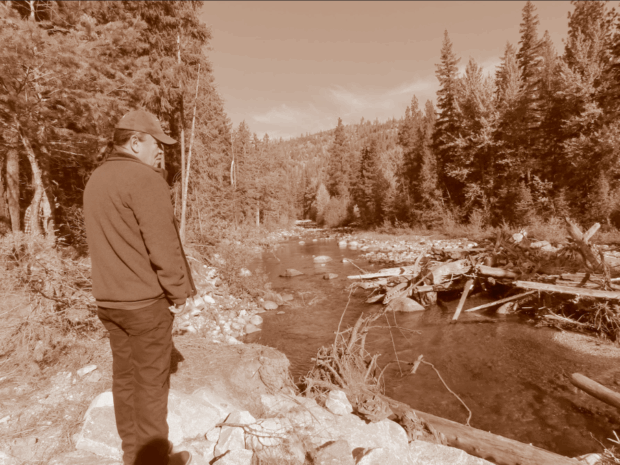
Photo source: Courtesy of Chelan-Douglas Land Trust. Wenatchi Elder Randy Lewis at Lake Wenatchee area,
Written by Chris Rader
Beautiful Lake Wenatchee has long been prized for its cool, refreshing waters and spectacular scenery. The area’s year-round population has grown in recent years, despite winters with colder temperatures and more snow than the rest of the Wenatchee Valley. The current residents are overwhelmingly white; some are retired, others work from home, but all relish the natural beauty of the lake and its surrounding mountains.
Much of Lake Wenatchee country, including about half of the lake’s shoreline, is national forest land. Two rivers, the White and Little Wenatchee, flow from the high Cascades into the lake at its west end. At the other end of the roughly six-mile-long lake, the headwaters of the Wenatchee River flow eastward and then south toward Leavenworth before heading east again to the Columbia River. Feeding into that upper part of the river are Nason Creek, which runs alongside the Stevens Pass Highway for miles, and the Chiwawa River descending southward from the volcanic Glacier Peak.
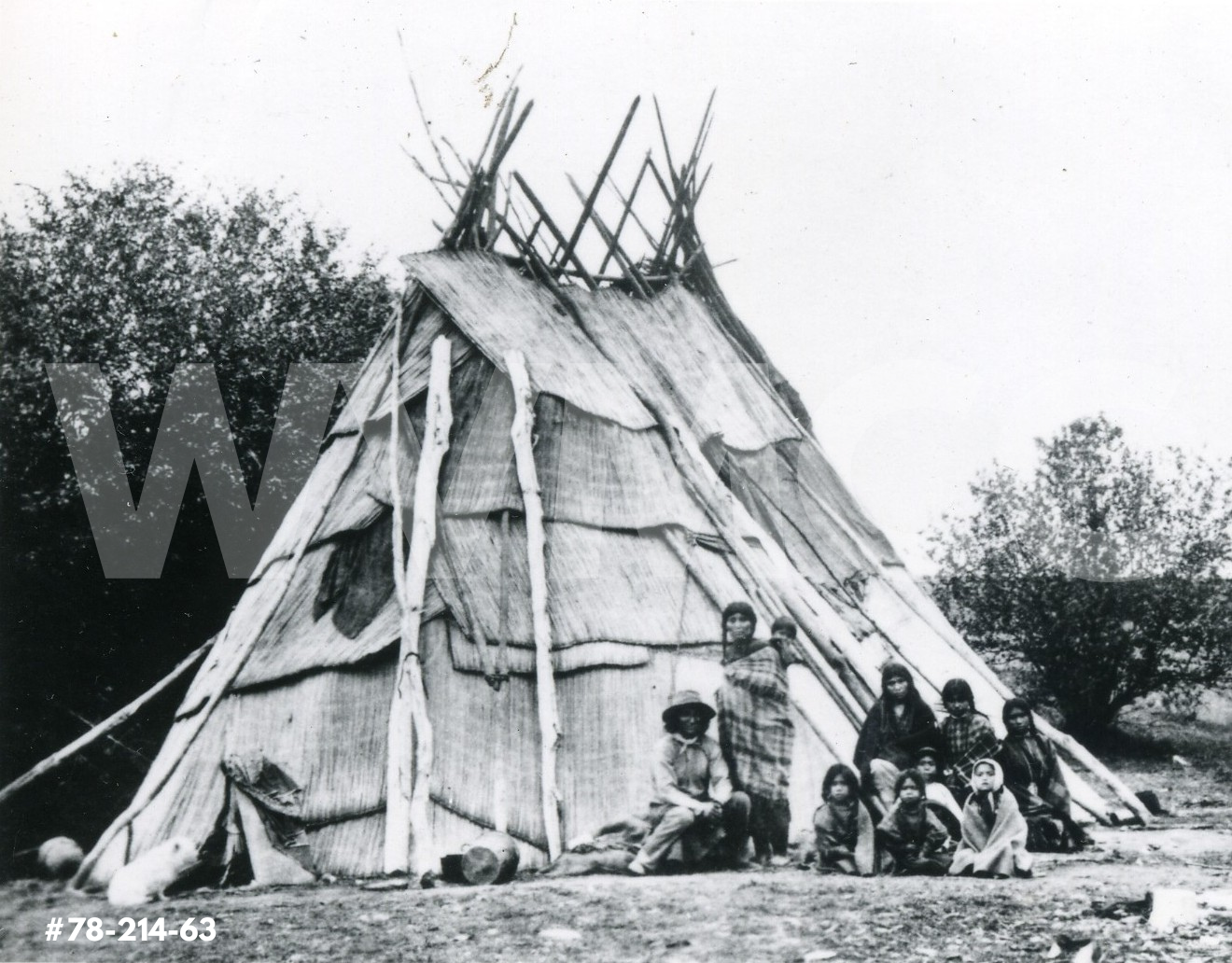
Photo source: WVMCC #78-214-63. Wenatchi-P’squosa people pose in front of a tule mat lodge c. 1890. This lodge is larger than typical tipis, and probably housed two families. Note the longer top, which differs from the usual conical tipi shape.
A state park and Forest Service campground at the east end of Lake Wenatchee overflow with campers and swimmers during the summer months. Numerous campgrounds and trailheads along the Little Wenatchee, White and Chiwawa rivers also draw visitors who like to fish, hike, ride horses or just relax in the deep quiet of these remote cedar, fir and hemlock forests. All of these rivers and creeks, Lake Wenatchee, and the nearby (smaller) Fish Lake contain a variety of fish – notably salmon and trout.
Caucasian civilization may now be dominant in the region, but indigenous people roamed these mountains and fished these waters for millennia before people of European descent showed up here in the late 1800s. The native people called themselves P’squosa, or Snp’sq’wawsxw. Like related bands of the Mid-Columbia region – the Entiats, Chelans, Methows, Columbia-Sinkiuse – they spoke a Salish dialect. The Yakamas, who lived further south, spoke Sahaptan; it was they who referred to the P’squosa as Wenatchi (including to Lewis and Clark), and that name stuck. As has been described in previous issues of The Confluence, the Wenatchi-P’squosa occupied the lands stretching from the Lake Wenatchee area down the Wenatchee River to the Columbia River, and then some miles north and south along the western shore of that large waterway.
On the Columbia the Wenatchi-P’squosa had large permanent villages at the mouths of Swakane Creek, the Wenatchee River, Squilchuck Creek and Stemilt Creek, as well as below Monitor, above Cashmere and at several other sites along the Wenatchee. They were a semi-nomadic people who roamed the mountains in spring, summer and fall to find and preserve food and medicinal herbs for the winter months. Following the seasons’ offerings, they camped for weeks at a time in lightweight portable tule-mat tipis while digging roots, fishing for salmon or picking berries before moving to
the next location.
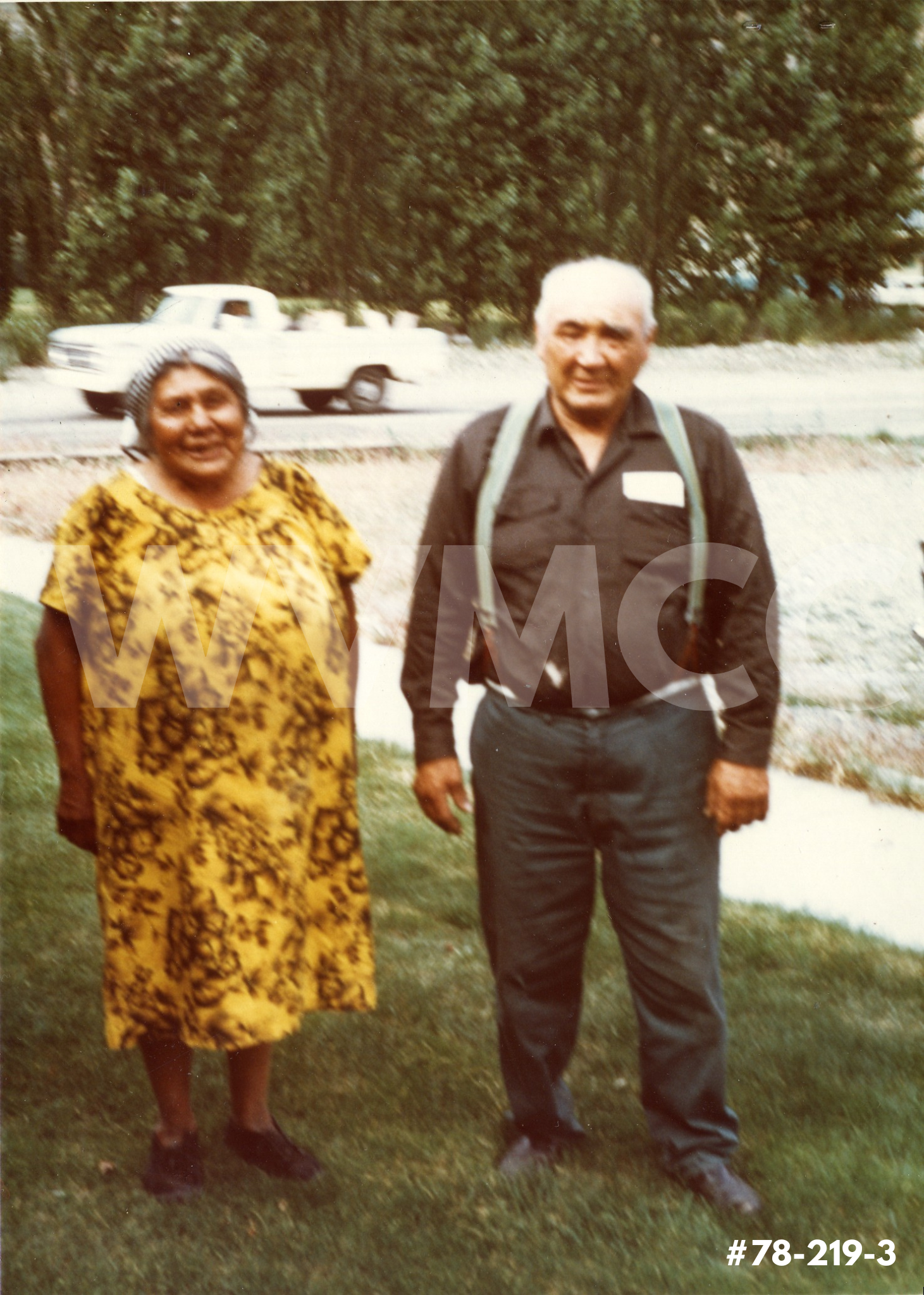
Photo source: WVMCC #78-219-3. Celia Ann and Matthew Dick at Cashmere, 1974. Celia Ann (Ieetum) was a granddaughter of Wenatchee Chief John Harmelt.
When the weather cooled, they headed for lower elevations to their winter villages. Here families lived in pit houses – dwellings with sturdy wooden frames covered with several layers of tule mats, erected over pits one to two feet deep. Living a little below ground level, people stayed warmer; ground temperatures stay relatively consistent at 55 degrees.
A lengthy 1987 paper for Washington State University’s Center for Northwest Anthropology described the “semi-subterranean” winter residential structures of the Wenatchi-P’squosa. Most of these were round, 15 to 20 feet in diameter, constructed over pits up to four feet deep. Others were longhouses shared by more than one family.
The Wenatchi long, winter dwelling, set in a pit about 1 foot deep, was constructed with parallel sides and rounded ends. It varied from about 18 to as much as 80 feet in length and from 14 to 20 feet in width. In cross section it was shaped like an inverted V, the two sides sloping straight from the ridge to the ground. The frame consisted of pairs of inclined pole-rafters set into the ground, the tops of each pair crossed and bound to the two ridge poles that ran the length of the structure. Down the sides the rafter pairs were also united by several longitudinal poles, to which they were lashed with willow cordage.
This frame was covered with overlapping courses of mats of sewn tules, each mat tied to the poles. Against the outside surface of the lowest mat course, grass was piled to a height of about 3 feet and then covered with earth. The space between the two ridge poles was left open along the entire length of the structure. Directly under it ran a center aisle of bare earth, on each side of which were the living areas with floors covered with rush mats. Along this middle walkway strip were placed the fires, each in a shallow pit; each fire served two families, one on either side of the dwelling (1).
A small handful of Wenatchi-P’squosa did not seek the lower elevations of the Wenatchee and Columbia rivers in winter. Evidence of year-round pit houses just east of Lake Wenatchee, around the confluence of the Chiwawa and Wenatchee rivers, was unearthed and studied by archaeologists in the 1980s and ‘90s. River banks have eroded and many of the pits are now under water, but the digs found large piles (“middens”) of freshwater mussel shells, projectile points, knives and fire-cracked rock. This settlement was known as Tclwa’x, an important fishing village with a summer population of about 100 with a large salmon trap located nearby (2). Only a few families stayed there year-round. Archaeologists estimated that occupation at Tclwa’x dated back to about 7,000 years ago.
Gathering huckleberries
For thousands of years, the Wenatchi-P’squosa came up to Lake Wenatchee, Chiwawa River, White River, Little Wenatchee River, Nason Creek and the headwaters of the Wenatchee River to fish, hunt and pick berries. They had several favorite huckleberry grounds, up the Chiwawa and Little Wenatchee drainages. Picking and drying huckleberries was work for women and children while the men fished or hunted for deer and mountain goat.
Wenatchi-P’squosa elder Celia Ann Dick, in a 1975 interview with Bernice Greene, fondly recalled picking berries with her family in the early 1900s. (Celia married Matthew “Bughouse” Dick and had several children, including William [1941-2013] and Mathew [1943-2018].) She described drying the berries in the sun on top of a wooden platform, with a slow fire of rotten wood under it until the berries were dry enough to store for winter.
We used to go after huckleberries up Chiwawa. We came to where we left our buggies. From there we went on horseback and crossed the river and followed a trail up the ridge six or seven miles to the top and on the other side to an Indian campground. We took the horses another mile and left them in a meadow. We blocked the route to keep them there.
On top, where we camped, there’s a little lake. My folks told me one time they saw a bear swimming in the lake. A creek came down by the horses so they had water. We used to get big huckleberries. We call them “s’w’n’ awh.” Another place where we picked huckleberries was across Nason Creek from Ray Rock Springs, about three miles up that road (3).
As a child, Mrs. Dick said her favorite part of the huckleberry-gathering trips was the evenings around a campfire. The men would smoke pipes filled with a mixture of kinnikinnick and tobacco, and the older men would tell stories. In an April 1, 1977 letter to Mrs. Greene, Celia Ann Dick added:
About huckleberries – my folks used to say that people would set fire to the bushes to kill the other trees growing up, and then the huckleberries would grow back. My grandfather remembered them burning that place on Huckleberry Mountain when he was a little boy. He told me it smoked so bad that it would be dark all day and the sun looked red. That must have been maybe 100 years ago. Another Wenatchi-P’squosa elder, Joseph Atkins, shared reminiscences with Bernice Greene about his childhood. He lived near Cashmere with his parents. In summer they would go to pick huckleberries on Huckleberry Mountain. Greene explained:
In a buggy, and leading other horses, they went from the Leavenworth area up Chumstick Canyon to Plain, where they sometimes camped. From there they followed up the Chiwawa River as far as Chikamin Creek, where they left the buggy. Then, on horseback, they crossed the Chiwawa River and went quite a distance up a trail to the top of that mountain. They usually set up camp there… The horses were then taken to a third ridge and left there to graze. In between was a large area where most of the berry picking was done. Joe described the lovely streams where they were supplied with plenty of water, also the beautiful meadows where the horses were left to graze. He remembers that one of his responsibilities was that of checking to make sure the barriers placed across the trail were adequate to keep the horses from coming back into the camping areas.
The Indians lived in tents and cooked on open fires. The women were the chief huckleberry pickers, although the children helped. They picked into baskets woven of cedar roots and hung onto the belts with thongs. The drying process was accomplished by a combination of sun and heat from a slow fire built along the edge of a log lying on its side. A slanting slope was scraped on the ground, with its lower edge reaching the fire. The huckleberries were spread on this slope on gunny sacks or canvas. The men watching the fire gently moved the berries back and forth so that all parts would dry evenly. When dry enough to prevent spoiling they were put into large cedar root baskets which were later tied onto the horses to be transported down the mountain trail to the buggies. Each family had its own drying place, usually sharing a fire with another family.
Atkins told Mrs. Greene that his and other families would camp for two weeks to a month at this and other huckleberry-gathering spots. He said he and some of the other boys enjoyed fishing for trout, even though it meant hiking down a very steep trail from Huckleberry Mountain to the first and nearest of the Twin Lakes. Atkins said the fishing was excellent and the boys had no trouble catching all they could carry back to camp (4).
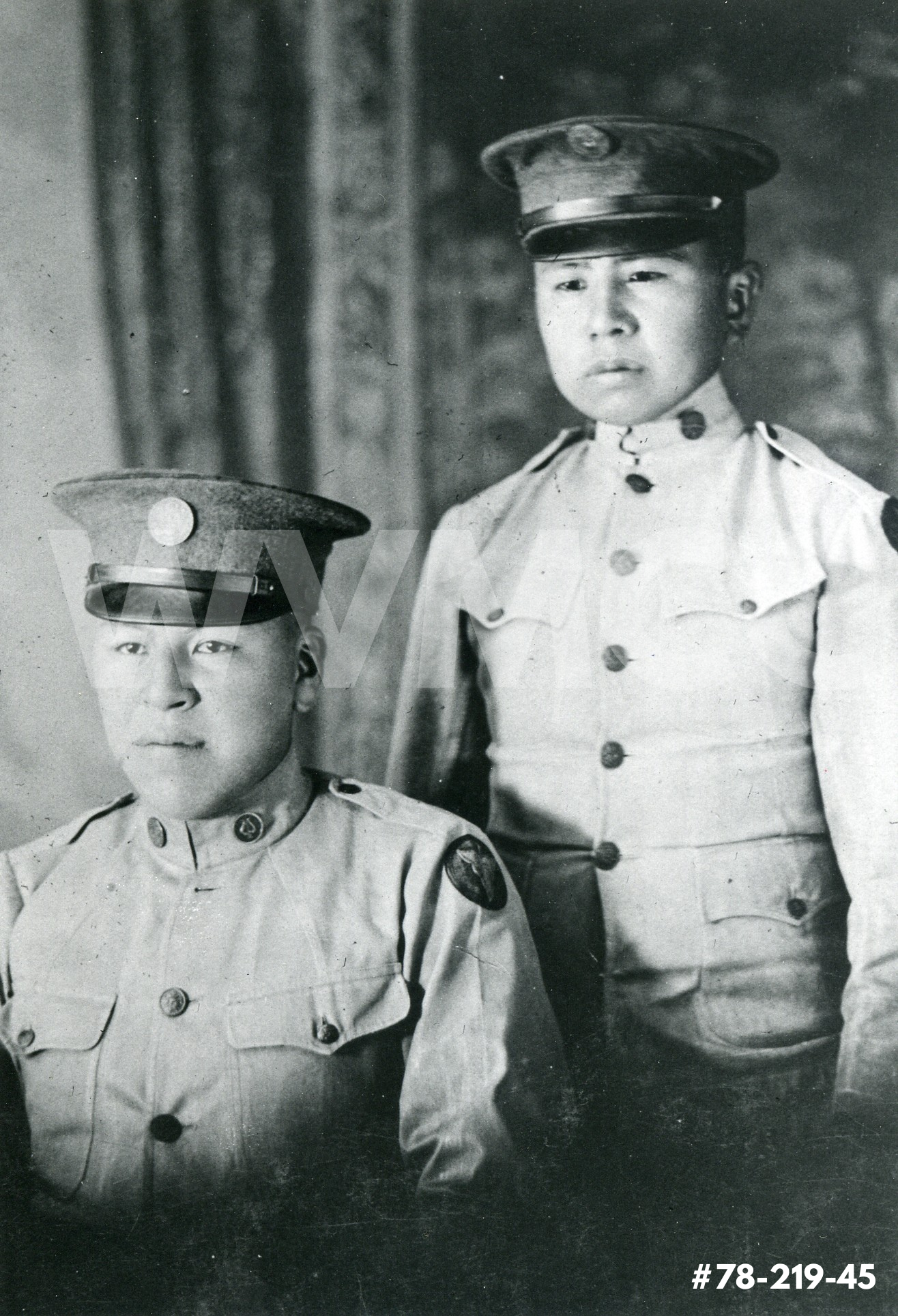
Photo source: WVMCC #78-219-45. Joe Atkins, left, and Ambrose Smartlowit served in the U.S. Army during World War I.
Fishing techniques
The Wenatchi-P’squosa did not fish with baited hooks, but with gaffs or spears. Sometimes they built wooden fish traps using green sticks about an inch thick, fastened with cordage from the Indian hemp plant, or speetsum. The sticks were lashed with willow strips into a cone-shaped basket, which was held to the bottom with rocks.
The shorter gaffs usually had handles of vine maple. Before metal was available, barbed points were often made of tough elk horn. According to Joe Atkins:
The point was fastened to a hemp cord with melted pitch, and the other end of the cord fastened to the pole the same way. The point was held in place in a notch at the end of the pole. When a fish was speared the weight of the fish pulled the hook from its notch and the fish was pulled in by the cord. This kept the pole from breaking. A few gaffs were used, but most salmon fishing was done with fishing spears (5).
Salmon were the basis of the diet for all of the tribes and bands living on or near the Columbia River. The yearly return of these anadromous fish (which spend part of their life cycle in the ocean) was a cause for celebration. Several species were plentiful in the Wenatchee River drainage: spring chinook, summer chinook, coho, sockeye and steelhead (actually an ocean-going trout). This variety helped stretch the fishing season over several months. Sockeye thrived at Lake Wenatchee and in the White River in summer, after the major harvest of spring chinook at the Wenatshapam Fishery at the mouth of the Icicle River (see The Confluence, summer 2018).
Randy Lewis, a descendant of the Wenatchi-P’squosa and Methow bands currently living in Wenatchee, learned of the “old ways” of fishing from his grandfather and other relatives.
ENDNOTES
- Allen H. Smith, “Contributions in Cultural Resource Management No. 14: Native American Tribes of the North Cascades National Park, Ross Lake National Recreation Area, and Lake Chelan National Recreation Area,” Center for Northwest Anthropology, Washington State University, March 1987.
- Jan Hollenbeck and Susan Carter, “A Cultural Resource Overview: Prehistory and Ethnography,” Wenatchee National Forest, April 1986.
- Celia Ann Dick, interviewed by Bernice Greene for Wenatchee National Forest historical records, October 1975.
- Bernice Greene notes on interview with Joe Atkins for Wenatchee National Forest archives, Oct. 22, 1980.
- Joe Atkins and Bernice Greene, 1977-78, Nespelem.
This story was originally published in Confluence Magazine in the Spring edition of 2021. In an effort to preserve these stories, the Wenatchee Valley Museum and Cultural Center will be posting these stories on the museum’s official blog.
Become a member to get a free copy of Confluence Magazine. Learn more about how to become a member here!
Interested in keeping a photo copy? Learn more about our photo archives and request your own copy below.