Wenatchee is a Baseball Town – 07/11/25
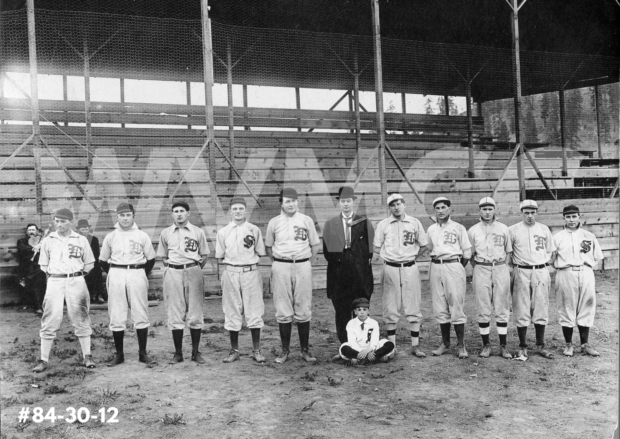
Photo source: WVMCC #84-30-12. Members of the Leavenworth Cubs team pose in Wenatchee’s new Recreation Park in 1910. The two towns were longtime friendly rivals.
Written by Chris Rader
“Play ball!” This universal cry can be heard all across the United States as umpires begin the game known as our country’s national pastime. Baseball appeared on the American scene in the 1840s as an outgrowth of a ball-and-stick game played in Great Britain. It grew in popularity during the Civil War, when soldiers on both sides played it as a diversion. After the bloody war, baseball became a great national unifier when veterans took the game home and organized teams in
their neighborhoods (1). The sport attracted spectators of all ages and was adopted by children, teens, college students and adults.
The first professional games were played in 1871 with the formation of the National Association of Professional Base Ball Players. The National League was organized in 1876 and the American League in 1901. The first World Series between the champions of those two major leagues was held in 1903; the annual early-fall contest is still one of the highlights of American sports.
For many decades, Black people were barred from participation in major-league baseball until Jackie Robinson was signed by the Brooklyn Dodgers in 1947. The popular first baseman was named Rookie of the Year that year and the National League’s Most Valuable Player two years later. Today talented Black, Native American, Asian and Latino players take the field alongside those of European descent. Space does not permit the description of the many baseball stars who arose during the past 100 years, from Babe Ruth and Ty Cobb through Mickey Mantle, Joe DiMaggio, Willie Mays, Roger Maris and Hank Aaron, to 21st-century Seattle Mariners: Alex Rodriguez, Ichiro Suzuki, Ken Griffey Jr., Randy Johnson and Felix Hernandez. The sport of baseball has endured through time!
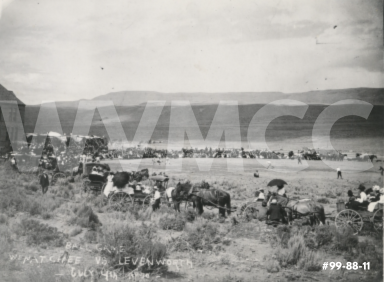
Photo source: WVMCC #99-88-11. A large crowd of spectators surrounded the baseball field behind Stevens School on July 4, 1900, to watch a game between Wenatchee and Leavenworth. Baseball was a chief source of entertainment in Wenatchee for decades – and still is!
Early Wenatchee Baseball
Even with a population of fewer than 300, Wenatchee fielded a baseball team beginning in the 1890s that played against teams from Leavenworth, Waterville, Cashmere, Chelan and other fledgling North Central Washington towns. The most frequent rivalry was against Leavenworth. The Great Northern Railway (completed in 1893) made it easy for fans to travel between the two towns to root for their respective teams. Special trains were chartered on Sunday afternoons between the rival towns, with flexible return trip times to accommodate the length of the ball games. A large crowd of 600 took the excursion train from Wenatchee (round trip 90 cents) to watch their team lose to the Leavenworth Cubs in early May 1911. In a rematch on May 29 Wenatchee defeated Leavenworth 7-3, this time with a large hometown cheering section riding eastward to observe.
The Wenatchee team went by several names, in the early 1900s: the Fruit Eaters, the Apple Pickers and the Apple Knockers. Games were covered lavishly in The Wenatchee Daily World, The Leavenworth Echo and other hometown newspapers. Previews and results of baseball games were page-one news, often with colorful play-by-play descriptions:
Grimly determined, the Leavenworth lads went to the bat, but the Wenatchee slab artist quickly relegated the first two to the bench. No. 3 went to first on a single and on to second when the next man accepted first on balls. Then came the sensational play of the game. Last half of ninth inning, tied score, and two men on bases. Mahoney picked up a club, with all his Irish blood aroused, and on the pitcher’s first delivery he swatted the ball so hard it was all but lost out beyond center field. He swung around the bases, easily making a home run, and the game ended with Leavenworth 10, Wenatchee 7 (2).
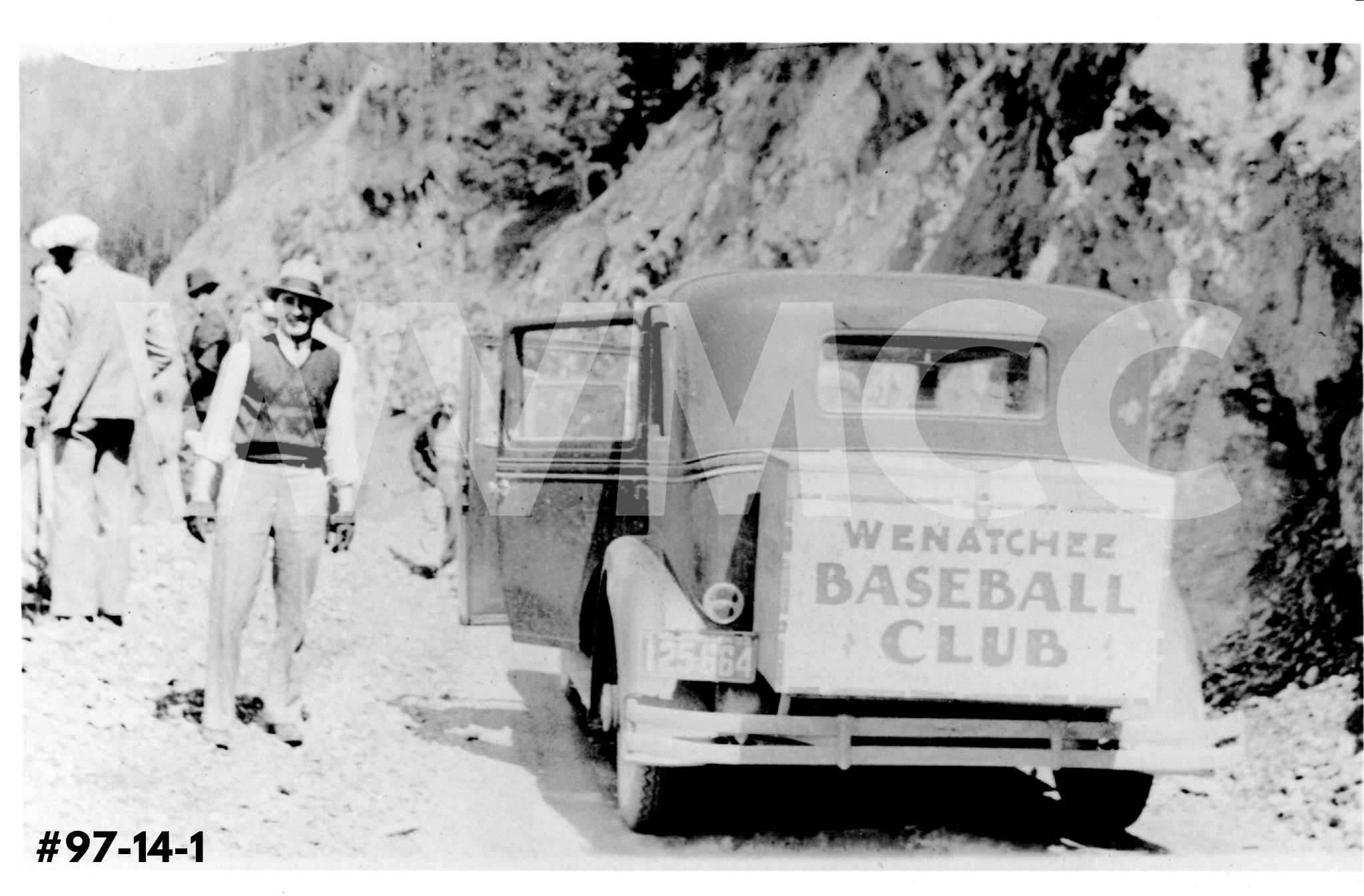
Photo source: WVMCC #97-14-1. Members of the Wenatchee Baseball Club stretch their legs on a drive to play a game against Nelson, B.C. in 1938. The team was sponsored by Bake-Lite Bakery.
In Wenatchee, home games first were played on a field behind Stevens Elementary School – near the current City Hall (and former post office building). This was an easy four-block walk from the train depot. Admission was 25 cents. Families would spread out blankets and enjoy picnic lunches and chit-chat a bit with other spectators as the games progressed. Baseball games were a mainstay of early Fourth of July celebrations, county fairs and Apple Blossom Festivals.
As seems inevitable in sports, some betting occurred on these local ball games. The track superintendent of the Spokane division of the Great Northern Railway, P.F. Connelly, was reported as generously distributing cigars after winning his $300 bet on Wenatchee against Leavenworth in June 1910 (3).
Wenatchee’s baseball diamond was moved to a new location in 1910 after four local businessmen purchased seven acres of undeveloped land along Miller Street and Orondo Avenue. They converted it into a park, planting trees and grass and building a fenced in baseball diamond and grandstand. Recreation Park became a popular gathering place not only for ball games but for fairs, circuses and family picnics.
In the mid-1910s Wenatchee played against teams from Snohomish, Monroe and Seattle, all accessible by train, as well as North Yakima, Quincy, Ephrata, Bridgeport, Reardan and Wilson Creek. A few of the hometown players were hometown bigwigs, such as attorneys Frank and Fred Reeves, steamboat captain Cliff Griggs, and fruit grower Sam Gehr. The names of team captains Harris (c. 1905), Taylor (c. 1908), Bill Hurley and (c. 1911-’20) Quigley appear in newspaper reports.
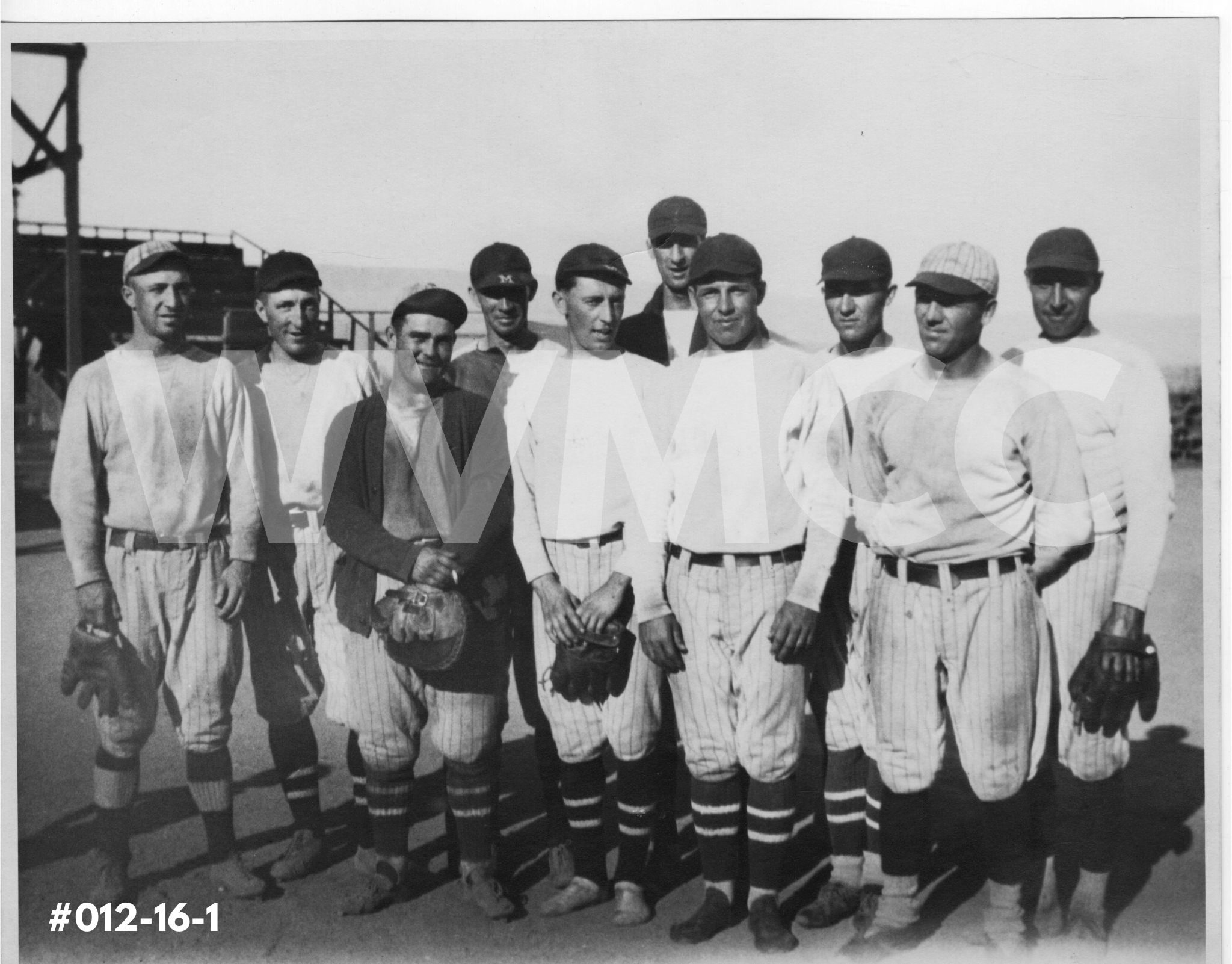
Photo source: WVMCC #012-16-1. The Morris Hardware baseball team, pictured above in 1928,was one of the best in Wenatchee’s Twilight League. At least five players had to work for a business for it to sponsor a team.
In those early years, most games were played on Sunday but some were scheduled on weekday afternoons. Local businesses closed down for special games in order that their employees and customers could attend, as on June 15, 1908 when a professional team from Vancouver, B.C. came to Wenatchee on a Monday. They arrived on the eastbound 4:35 a.m. train and returned on the 4:15 p.m. Coach Taylor stated that “approximately every place of business in Wenatchee would close from 12:30 noon to 4 p.m. to enable their clerks to see the game. The band will be present and give a concert before the opening of the game (4).” The Apple Knockers lost, 6-0, but the “gate” (ticket income) was high as people came from all over Big Bend country to watch.
In 1915 a Wenatchee Valley league was formed. It consisted of Wenatchee, Leavenworth, Cashmere and Monitor. It is probable that the Apple Knockers stopped playing against the more distant teams around this time. Monitor did not have a good ballfield location, so its team only played “away” games. The Leavenworth-Wenatchee rivalry continued through the 1920s.
Twilight League and youth teams
Overlapping the intracity league play, beginning in the early 1910s, was Wenatchee’s Twilight League. This was comprised of teams of coworkers, lodge members or business associations such as the Realtors, Brokers, Fruit Packers, Elks, Tammany Eagles, Moose, Firemen, Bankers, Electrics, Icemen, Ellis Forde, Wells and Wade, Morris Hardware and Jack Waugh’s Tavern.
Admission to the games at Rec Park was a mere 15 cents, a dime less than for the town teams’ games. Attendance was high, especially during Prohibition when saloons were closed and baseball provided the town’s most consistent entertainment. In the late 1920s and early ‘30s Morris Hardware was the team to beat, winning pennant after pennant.
Of course, with adults taking baseball seriously, it is no surprise that teams were formed for boys as well. (This writer has found no evidence of early girls’ softball teams; did they exist?) Before Little League, teams of sixth-grade boys from each local elementary school played each other. In 1954 Wenatchee Youth Baseball was formalized through the efforts of five men: Dr. Al Stojowski, Dr. Les Hildebrand, Al Libke, Rich Richardson and former Wenatchee Chiefs player Jim Nicholson. “Finding any open field or green pasture land, these men laid the foundation to an organization that today hosts upwards of 500-600 boys and girls each year in the appreciation of America’s favorite pastime,” says the introduction to a 50th-anniversary pamphlet celebrating Morris “Little
League” Park in 2001.
Baseball enthusiast and hardware store owner Al Morris donated his property on Cherry Street in 1961 to be developed into a youth baseball field. An adjacent parcel was donated to Wenatchee Youth Baseball in 1968 by his widow, Mary Morris. At Al’s request, the property would only be allowed to house youth baseball (though now the Wenatchee Exchange Club holds Christmas tree sales there in December, with proceeds benefiting youth sports and scholarships).
Today, Wenatchee and East Wenatchee youth teams are proficient and competitive. Both Wenatchee Youth Baseball and Eastmont Youth Baseball have four divisions following national Cal Ripken league guidelines: T-ball, Rookie, Minor and Major. For many years the late Ed Sandhof was WYB league organizer; current president is Tony Scherting. In 2021 Wenatchee’s U12 (under age 12) all-star team was Washington state champion, and Eastmont’s U11 team won the state championship.
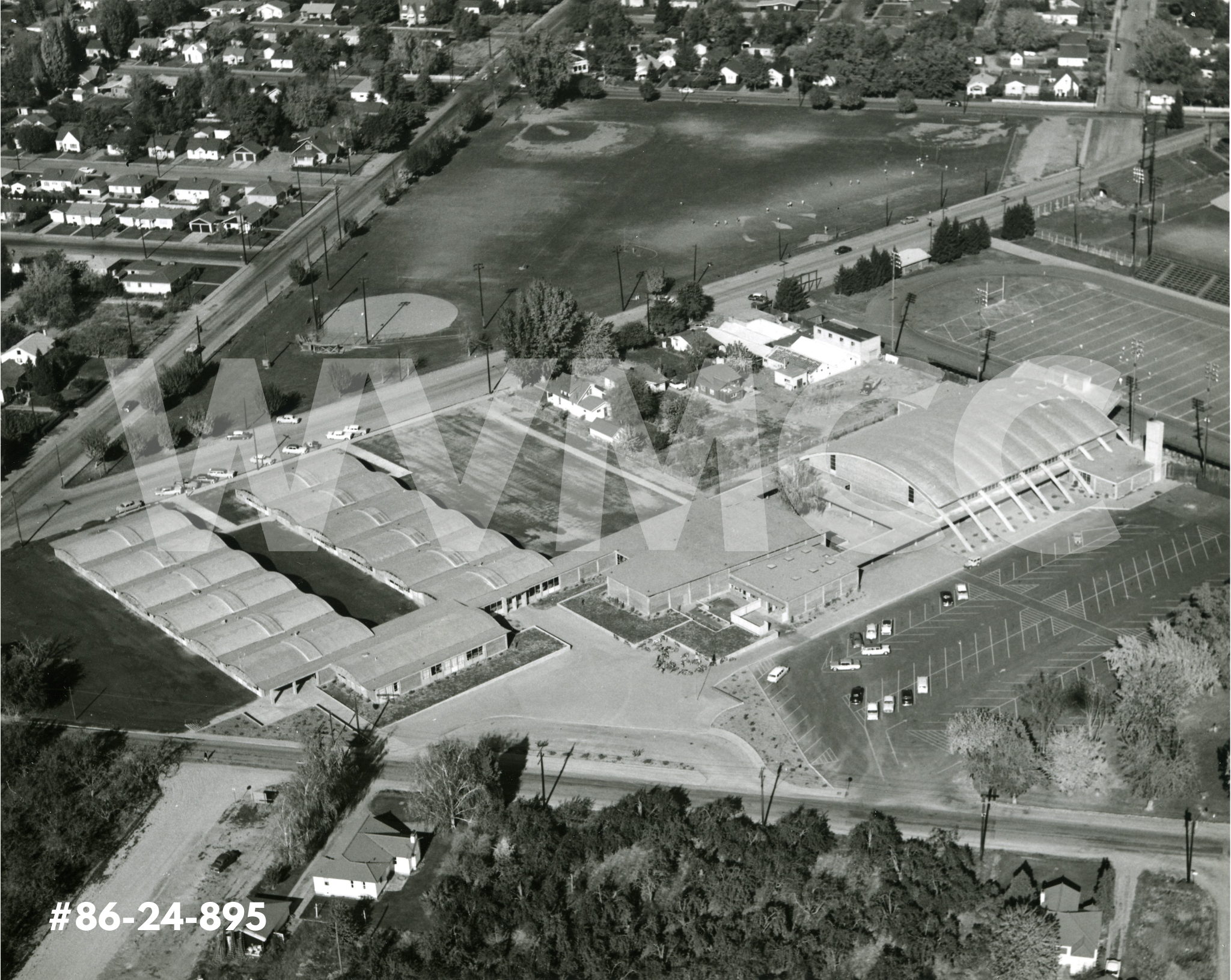
Photo source: WVMCC #86-24-895. This north-looking photograph, taken on Sept. 28, 1959, shows the new Pioneer Junior High School and Triangle Park, with its three baseball diamonds, in the background. Rec Park is just out of view, off the upper right of the photo. Orondo Avenue still ran from Cherry Street (upper right) to Miller Street (middle left), making it clear how Triangle Park got its name.
Fast-pitch softball
The late John Kalahar, long-time Wenatchee Valley College instructor and coach, played Little League baseball from its start in 1954. He recalled playing at Triangle Park and then Morris Field. He went on to play Babe Ruth and then American Legion ball (16 to 18-year-olds) as well as on junior high and high school teams. He told this writer in 2012 he would have liked to play college ball but tore his knee in high school. He did play on Alcoa’s fast-pitch softball (FPS) in the Wenatchee Valley Softball League from 1963 to ’68. Other FPS teams were Texaco/Vail Roofing, the Wenatchee Rainiers (B&F Distributing), Tom’s OK Tires, Keyes Fibre, Joe Williams Agency, the Lucky Drafters, Dusty’s, Wenatchee Olys (Burns Distributing), Sugg’s Tire Service and Lighthouse Tavern, which became the Wenatchee Merchants.
Kalahar went on to play for the Merchants 1969-77, Knutson Lumber 1978-80, and Triple C 1988-89. He said Terry Mace was CEO of the healthcare company and pitcher for the team. Kalahar coached those teams as well as playing catcher and/or first base and was inducted into the FPS Hall of Fame in 1988. He recalled the Sugg family as being talented baseball players with Harold Sugg a dominant pitcher in the 1930s. Son Mike Sr. and grandson Mike Jr. were also standouts, and great-grandson Dylan Sugg was a star on the Wenatchee High School team.
“Fast-pitch tournaments were a big thing in Wenatchee,” Kalahar said. “A thousand people would come watch. The Wenatchee Class A FPS winner went to state 20 times during the 1960s through 1980s, with the most decorated team the Wenatchee Olys.” The sport was popular throughout the state during those decades, with three metro leagues (Seattle, Spokane and Tacoma) and other teams in Walla Walla, Port Angeles, Longview and elsewhere. Wenatchee’s FPS teams played at Triangle Park, with games broadcast by KPQAM. Back then, Orondo Avenue still went through to Miller Street with the ballpark on a triangle of grass to the west.
Kalahar said the men’s FPS league folded in the late 1980s. Meanwhile, Wenatchee Valley College fielded a women’s modified FPS team beginning in 1984 and he was its first coach. The Lady Knights were the only NWAACC (Northwest Athletic Association of Community Colleges) team in Eastern Washington; they played eight teams from the west side including University of Puget Sound and Pacific Lutheran University. “It was the winningest program of all WVC sports,” Kalahar said in 2012. “We always won our division but not always the league.” Shelly Pflugrath then coached the championship team for 17 years, ending in 2016. WVC women now play slow-pitch softball.
Senior softball
Slow-pitch softball for older men began in Wenatchee in 1988. Wenatchee Senior Softball is still going strong, with 16 teams playing each year from April through mid-July. Players must be 48 years old (or 35 for women). The league has three divisions, ranging from very competitive to purely recreational. It sponsors four tournaments throughout the season – and many senior softball players participate in multiple tournaments throughout the West. Wenatchee has sent good players to the Huntsman World Senior Games in St. George, Utah, over the years; many of these teams have brought home gold, silver or bronze medals.
Pete Maxson has been involved with the senior softball league for 27 years, as a player and sponsor (PJ’s Excavation) and coach. He pointed out that the league includes players from all over North Central Washington. Currently there are two teams from Omak and two from Winthrop, with players from Quincy, Leavenworth and other towns joining the eight Wenatchee teams. Games against the northern teams are played in Chelan; Wenatchee home fields are Walla Walla Park and Hydro Park.
“We try and accommodate players from throughout the region – as many people as have the interest and desire to play,” he said. At the beginning of each season, new players are evaluated during practice games and assigned to teams matching their ages and/or abilities.
“Normally it’s age 62 for the recreational teams, but if somebody is 50 and partially disabled we put them on a lower team. We try and equalize everything.” Business sponsors such as Midland Truck and Farmers Insurance pay for uniforms, which can range from T-shirts to fancy, expensive garb. Maxson said about a dozen women participated in Senior Softball in 2021.
“It’s a lot of fun!” he said. “We’ve got a few guys out there in their 80s, still running the bases. We try and provide the means and the competition they can play with. It seems like softball gives people a focus for being active, staying in shape – and they tend to live longer.”
In addition to “citizen baseball” as described in this article, Wenatchee fielded a professional team for more than two decades and currently is the home for a summer collegiate team in the West Coast League.
Endnotes
- www.baseballhall.org.
- “Leavenworth Wins 2 Games,” Leavenworth Echo, June 19, 1908.
- “Has Faith in Success of Wenatchee,” Ibid., June 10, 1910.
- “Baseball Dope,” Wenatchee Daily World, June 12, 1908.
Additional Sources
- John Kalahar conversation with Chris Rader, spring 2012.
- Chris King e-mail to Chris Rader, July 3, 2021.
- Wenatchee Valley Museum, text from 2012 exhibit “Baseball in Wenatchee.
This story was originally published in Confluence Magazine in the Fall edition of 2021. In an effort to preserve these stories, the Wenatchee Valley Museum and Cultural Center will be posting these stories on the museum’s official blog.
Become a member to get a free copy of Confluence Magazine. Learn more about how to become a member here!
Interested in keeping a photo copy? Learn more about our photo archives and request your own copy below.